



Holland Bloorview Kids Rehabilitation Hospital’s Clinical Brain Computer Interface (BCI) Program supports children and youth with disabilities to engage in play, regardless of their physical ability. We believe that all kids should have the opportunity to play video games, create art, drive a remote-control car, or DJ a dance party.
Our Program
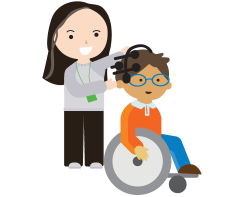
Learning to use a BCI is a lot like learning to play an instrument. It takes training and practice. The more a participant practices, the better they can get at focusing and controlling the BCI. Our occupational therapists and therapeutic recreation specialists work with children and youth in both individual and group sessions to help them build their skills and have fun.



 Looking to learn more or get started with our program? Get in touch with our team lead:
Susannah Van Damme, OT Reg.(Ont.)
(416) 425-6220 Ext. 7365
Email: BCI@hollandbloorview.ca
FAQ
Any child or youth with a disability in Ontario can try a BCI at Holland Bloorview! Participants are expected to come onsite for the initial BCI trial and should be able to tolerate at least 30 minutes of a session. We work with each participant to make the experience as supportive and accessible as possible.
Individual sessions are up to 60 minutes long. Sessions usually begin with about 10–15 minutes of setup and calibration, during which the headset is adjusted and trained to recognize the person’s unique brain signal patterns.
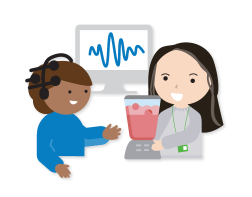
The following 30–45 minutes are focused on play, exploration, and activities using the BCI. For first sessions, we often aim to end about 10 minutes early to talk about next steps and answer questions. Many participants enjoy playing right up until the end of the session, while others find using a BCI mentally tiring and prefer to stop earlier.
The number of sessions varies based on individual goals, interests, and needs. Typically, participants attend 1-3 BCI sessions with an occupational therapist and then set goals and establish a plan.
Some goals lend themselves to additional individual occupational therapy sessions to develop BCI skills. Other goals are best met by participating in therapeutic recreation groups that focus on play and social connection. Finally, some goals may relate to using a BCI at home. In those instances, participants can join our home loan program.
All sessions take place onsite at Holland Bloorview Kids Rehabilitation Hospital. Depending on the activities planned for the day, sessions may be held in different rooms. Some are equipped with a television for activities such as video game play. For families borrowing equipment for home loan, virtual sessions can be scheduled to support troubleshooting and activity planning.
Each session is facilitated by a clinician, either an occupational therapist or a therapeutic recreation specialist. A technical support team member also attends the session and is responsible for setting up the equipment, ensuring the software is working properly, and troubleshooting any technical issues as needed.
This team‑based approach allows the clinician to focus their full attention on supporting the participant’s experience, learning, and engagement throughout the session.
Sessions are attended by the BCI participant and their caregiver(s). Due to room size limitations, we recommend that no more than two to three caregivers or family members attend a session at one time. For therapeutic recreation groups, caregivers are encouraged to drop their participant off and wait for them on the main floor.
During BCI sessions, two main software programs are used: Mindset and EmotivBCI. Mindset does not store any data. EmotivBCI stores only EEG data associated with a username. Usernames can be initials or a nickname and do not include identifying information. This helps protect the user’s privacy. EEG data on its own is not personal information and cannot be used to identify an individual.
When a participant is no longer part of the program, their username and associated data will be deleted locally. EMOTIV may retain EEG data.