

When your child has a disability, who pulls away and who stays?
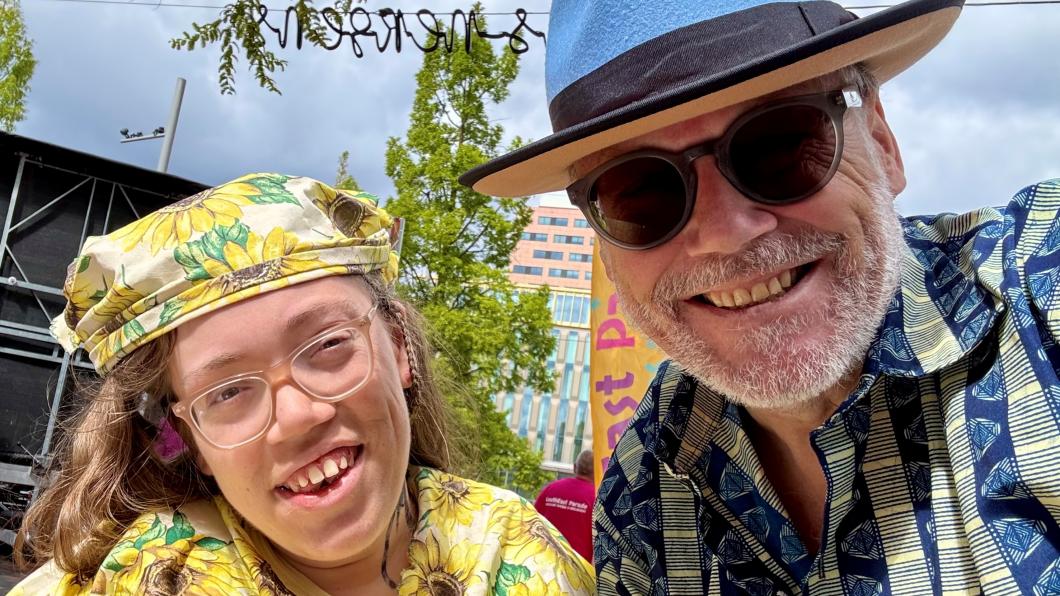
Photo of Marcel Kolder (right) and his daughter Mayim.
I read this perceptive piece by Marcel Kolder, a father in the Netherlands, on LinkedIn. It reminded me of a fascinating book called Being Ill: On Sickness, Care and Abandonment. It is about how the stigma of illness and disability causes people to scatter, and the ill or disabled person, and their family, become isolated. The authors say this abandonment is particularly acute in Western, educated, individualistic, rich and democratic societies. What is lovely about Kolder's piece is that he examines not only who has left his social circle, but who remains.
By Marcel Kolder
I’m a single dad to a child with a disability. My social circle has shrunk, as these things tend to go. Not dramatically, but noticeably. It’s gotten quieter. And right in that smaller circle, I’ve found a striking number of people who also live outside the norm: people whose bodies don’t work the way they’re “supposed to,” lives that took a different turn. Trans people. LGBTQ+ friends. People who once fled their countries: Afghans, Iranians, Kurds, Indonesians, Surinamese.
Statistically, that doesn’t add up. At least not if friendships form completely at random. But friendships follow different rules. They follow gravity.
There’s such a thing as the average life. You grow up, find a partner, have kids, build a career, grow older. The future lies open, but within recognizable lines. As long as you’re moving along inside those lines, you don’t feel it as a position. It just feels like the world itself. Only when you fall out of it do you realize it was one.
When my daughter’s disabilities permanently shaped our lives, my place in that world shifted. When Michelle, my wife, passed away, it wasn’t just my family that shifted — my place in the world shifted again. Invisible to others, but deeply felt by me. My life became less interchangeable. I couldn’t plug in everywhere anymore. Not every conversation fit, not every concern was recognizable. My schedule followed different urgencies, my horizon different boundaries. It’s not a complaint. It’s a new geography. You move without ever changing location.
The most surprising part wasn’t who showed up, but who disappeared. Old friends, family. Not with a bang, not with hostility, but slowly. People have their own lives, their own vulnerability to protect. Seeing someone else’s visible breaking reminds them of the fragility of their own existence. That’s not a moral failure — it’s a human reflex. Still, it has consequences.
The people who stay are often those for whom life was never taken for granted. People who know what it feels like not to blend into the norm. Who know the exhaustion of having to explain, or the peace of no longer needing to.
What stands out is this: our stories rarely resemble each other. My loss isn’t their loss, their struggle isn’t mine. And yet there’s recognition. Not in the facts, but in the shift. In the realization that your life no longer matches the standard story. That you’ve come to inhabit a minority position, whether chosen or not. That you have to navigate a world that doesn’t make room for you. That creates a different kind of closeness: not ideological solidarity, but a quiet, recognizable intimacy.
My world has become smaller. That’s a fact. But it has also become more honest. Less performance, fewer expectations, more pure presence.
Sometimes I think a human life shows its true shape most clearly in who ultimately remains. Not as a conscious choice, but as a map. A map of fractures and adaptations, of loss and attraction.
Like this content? Sign up for our monthly BLOOM e-letter or take our short BLOOM survey.