


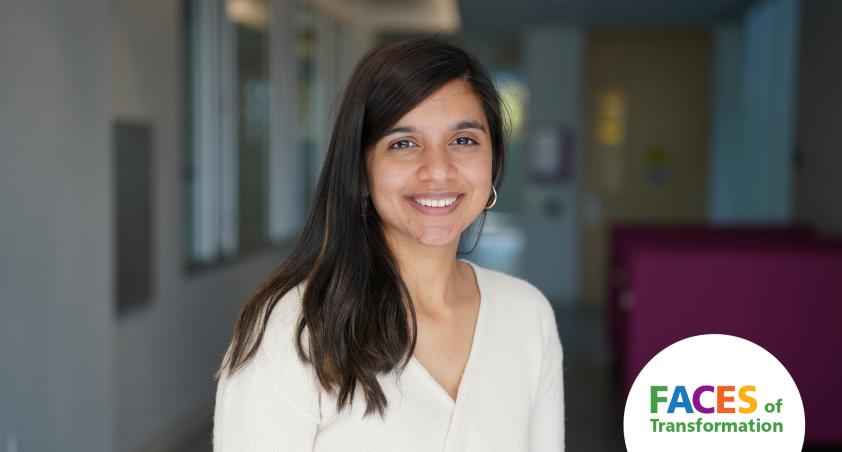
Meena Kadiwal joined Holland Bloorview about two years ago, drawn by the hospital’s strong rehabilitation focus and commitment to supporting children with complex neurological needs in a truly holistic way.
“What really stood out to me was the depth of interprofessional collaboration, how medical, behavioural and therapy teams come together to support clients with severe interfering behaviours,” she shares.
As a nurse practitioner with the Extensive Needs Service (ENS) team, Meena supports children and youth with complex neurological diagnoses and severe interfering behaviours. Her work centres on holistic, family‑centred care, helping clients progress in their rehabilitation and, whenever possible, supporting their transition back to home, school and community environments.
Read on to learn more about Meena:
What has your career journey here been like so far?
It has been incredibly rewarding. I’ve had the opportunity to learn from and work alongside a wide range of professionals – physicians, behavioural therapists, nurses – and that level of support has been instrumental in my growth. The team-based environment has allowed me to deepen my clinical skills while gaining a greater appreciation for how collaborative care drives better outcomes, especially when helping clients transition back to their communities.
What does a typical day look like for you?
No two days are the same. A typical day might involve assessing clients with complex neurological conditions, addressing behaviours that interfere with rehabilitation progress and adjusting care plans to support both safety and functional gains.
I spend a lot of time collaborating with the team and families to ensure we’re working toward shared goals, often focused on helping the client build the skills needed to transition back to community settings.
In what ways have you seen care delivery evolve during your time in ENS?
I’ve seen a shift toward more integrated care, especially in how we approach the intersection of neurological conditions and severe interfering behaviours. There’s a stronger emphasis on proactive, team‑based strategies that support both regulation and rehabilitation.
We’re also much more intentional about planning for discharge and community reintegration early in the care journey, which leads to smoother transitions for families.
As a nurse practitioner, how do you influence team-based care and decision‑making?
I help bridge the gap between medical care and day‑to‑day functional outcomes. I bring a lens that considers how neurological conditions and behaviours interact, and how that impacts a child’s ability to engage in rehabilitation and eventually return to their community.
My role allows me to contribute to clinical decision‑making while ensuring care plans are practical, coordinated and aligned with long‑term goals.
Can you share a success story or example of impact?
One case that stands out involved a child with complex medical and developmental needs whose care had been fragmented across multiple services. When he presented to ENS, he was experiencing hundreds of head‑banging episodes per day.
Through close coordination between medical and behavioural teams, we developed a unified care plan addressing both neurological and behavioural factors. Over time, these behaviours were reduced to a minimal level. The impact was profound—not only for the child’s ability to participate in daily life and rehabilitation, but also for the family’s overall well‑being, particularly maternal mental health. Seeing that transformation was incredibly meaningful.
What are the biggest challenges in your role, and how do you navigate them?
Balancing medical complexity with behaviours that significantly interfere with care and rehabilitation can be challenging. Finding the right combination of strategies often takes time. I navigate this by staying patient, using a team‑based approach and continuously reassessing what’s working always keeping long‑term community reintegration in mind.
I try to maintain balance by prioritizing time outside of work being active, spending time with family and friends and getting outdoors. I also pause to reflect on small wins, especially in an environment where progress can take time.
What opportunities do you see for further transformation in ENS or NP‑led care?
There’s strong potential to expand NP‑led models that support children with complex neurological needs and severe behaviours. Enhancing early intervention, strengthening community partnerships and improving transitions back to home and school could have a significant impact. I also see opportunities for NPs to further shape care models that integrate medical, behavioural and rehabilitation approaches.
What are you most proud of in your career so far?
I’m most proud of being part of the process that helps clients move from instability to re‑engaging in daily life. Supporting children and families through that journey especially when the path is complex, is deeply meaningful. I’m deeply grateful to be part of Holland Bloorview Kids Rehabilitation Hospital, where visionary leadership and an exceptional interprofessional team make this work possible.
Do you have any hobbies or sources of inspiration outside work?
I enjoy creative and active outlets that help me recharge. I’m a henna artist and a dancer, which allow me to express creativity and stay connected to culture and movement. I also love spending time in nature and building LEGO with my four‑year‑old son, it’s a fun and meaningful way to unwind together.