


Social worker is an anchor for families in medical crisis
Photo by William Lam
By Louise Kinross
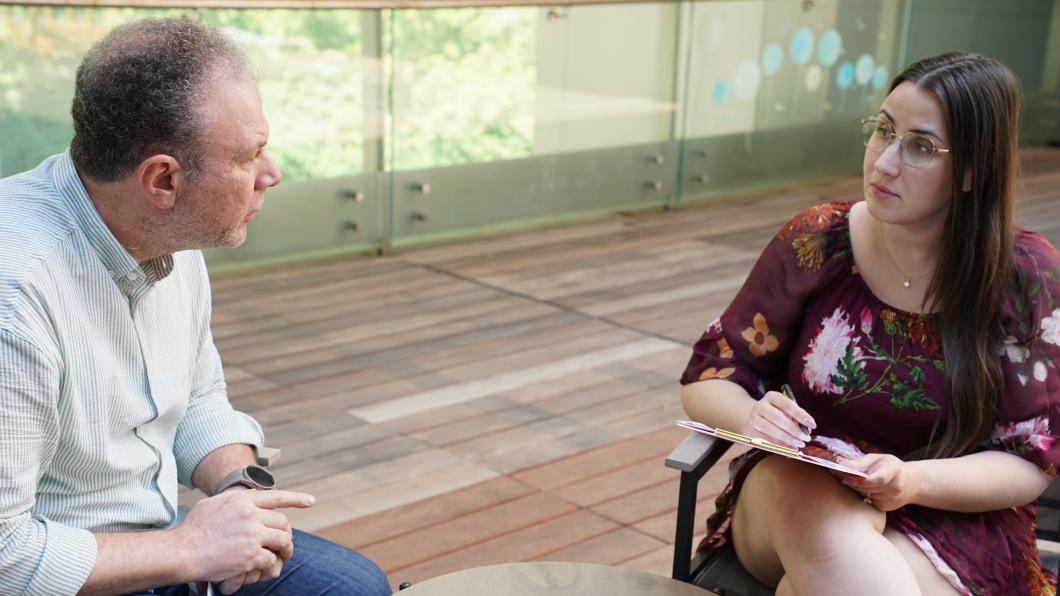
Anna Hensen (photo right) is a social worker at Holland Bloorview working with children with complex medical problems and their families. Her interest in this population developed after she was diagnosed with an autoimmune condition as a teen and benefited from the support of a social worker at the Hospital for Sick Children. "She really got me to a point of acceptance and made me feel very seen," Hensen says. "I wanted to have that impact on others."
BLOOM: How did you get into this field?
Anna Hensen: I was diagnosed with Lupus when I was 13, so during that time it was a really big adjustment for me. I had a social worker at SickKids who supported me. She was incredible and she’s still a mentor of mine to this day. She really got me to a point of acceptance and made me feel very seen. I wanted to have that impact on others.
BLOOM: What were the challenges receiving that diagnosis, especially at what can be a tough age?
Anna Hensen: It was an adjustment of going from being typically developing to having a plethora of different ailments as a 13-year-old. Honestly, I was really embarrassed at first, socially, because I was missing a lot of school. I was going to a lot of appointments. I looked a bit different because of the medications I was taking.
A large impact of my physical diagnosis was emotional, and that’s where the social worker came in as that emotional support for me! I had to come to a place of comfort in being able to advocate for myself. If I needed accommodations on tests, or if I needed to get a doctors note for XYZ, I learned to figure all of that out.
There were a lot of moving pieces and having Lupus disease is interesting in that it’s an invisible disability much of the time. I had to learn how to communicate that to people, so that they understood maybe why I wasn’t able to do something, even though I looked completely fine.
BLOOM: How did you move from your personal story to studying social work?
Anna Hensen: My ultimate goal has always been working in pediatrics because of my history. When I turned 18 and was choosing schools, I had already set out my path. I did my undergrad in psychology at Queen’s University, and I went to the University of Toronto for my master’s in social work.
BLOOM: What is a typical day like here?
Anna Hensen: We attend medical rounds where we go over the last 24 hours for each client to see if anything has come up medically, or there are psychosocial pieces that we need to follow up on. I do check-ins with families to provide supportive counselling. We also have family team meetings which are interdisciplinary, where we all come together to discuss clinical updates and discharge planning.
I have weekly, standing check-ins with most families, and if a family has higher needs, I might meet with them more frequently. Sometimes families come to my office when they’re having an especially rough moment. We also support families that are making the transition from Holland Bloorview back home. That might mean helping with funding applications for equipment, or advocacy work with other organizations to get supports in place. That comes with its own share of emotional and logistical challenges to make sure that families have the supports they need in the community, while also feeling ready themselves.
BLOOM: What are the most common concerns you hear from families?
Anna Hensen: A lot of the concerns come from adjustment to the diagnosis and coming to terms with this new reality. Sometimes the changes happen overnight, so there’s a lot of trauma there. It’s tough to suddenly go from life being business as usual to living in a hospital and not knowing what’s going to happen next with your child.
There’s a lot of uncertainty. A lot of my work is based on supporting families with navigating that uncertainty, pain, and feeling a lack of control. I often support coming to a place of acceptance and being able to take the next steps forward, rather than being stuck, which a lot of families feel.
BLOOM: How does having a chronic illness inform the way you counsel children and families?
Anna Hensen: Living with an invisible disability has given me insight into how illness does not just affect the physical body—it affects routines, relationships, finances, and the list goes on. When I provide counselling I am grounded in exploring the multi-faceted experience of medical complexity and focusing on what is important to the individual.
With my diagnosis there was a lot of “bad” that came out of it, but lots of positive things too. If families are ready, I try to empower them to anchor into what they have gained from their experiences, in addition to discussing the losses, which can be very powerful. I have supported countless caregivers who have told me that they did not know how strong they truly were until they had this experience, and there is so much beauty in that realization.
BLOOM: What would you say is most challenging about your work?
Anna Hensen: Navigating ever changing systems. A lot of times the barriers to discharge are systemic in nature. We are looking to get nursing hours and nursing isn’t available, or we’re looking to get a different kind of support, and it’s not available where the client lives.
A lot of it isn’t within our control when we’re talking about external agencies. We can make referrals and do the advocacy work but at the end of the day sometimes we run into roadblocks, and we have to problem solve to figure out how to get around them. What else can we put into place to make this a safe discharge? It’s frustrating on the clinician side and the family side.
Another challenge we’re seeing is the high cost of living impacting medical costs, and things in general becoming less affordable. It’s a lot harder for families to access what they need. We’re seeing more families that do not qualify for funding support based on their income, but their entire income is going towards rent and food—so they need the help too, but they are not eligible.
BLOOM: What are the greatest joys?
Anna Hensen: I love working and connecting with children and families. I love being a space where they’re able to express themselves and be able to talk through things that maybe they’re not even comfortable talking about with their own family. It’s an honour and a privilege to get to support them in what for some people is a very dark season of their life.
I really enjoy working with my colleagues as well. The interdisciplinary team here is incredible. Being able to coordinate with them to support families in the best way that we can is a great joy and helps keep me grounded because supporting families is heavy work. Having that interdisciplinary team to debrief with and get recommendations from is really valuable.
BLOOM: Have you learned anything in your role that surprised you?
Anna Hensen: I would say the barriers we run into when advocating for our clients never cease to surprise me. Things that intuitively you know a client should be eligible for and then we’re given a no. That’s always disheartening and it’s always surprising for me, especially working in pediatrics. I feel that when you’re dealing with medically complex children the answer should always be yes.
BLOOM: What emotions come with your job?
Anna Hensen: All of them. When you’re sitting with a caregiver and talking about their situation, through empathy you feel things along with them. When they’re feeling despair, to an extent you’re feeling that despair. When they’re feeling hopeless, to an extent you feel that hopelessness. I also feel so much joy, pride and awe seeing clients and their caregivers make strides.
BLOOM: Is there anything specific you do to manage stress?
Anna Hensen: Yes, I read a lot and I have two Ragdoll cats at home. Their blue-eyed and fluffy, and so the cats along with my husband are my support system.
BLOOM: What do you read?
Anna Hensen: I tend to read fiction because life is enough. I do literary fiction.
BLOOM: What qualities do you need to be good at your job?
Anna Hensen: You need to be empathic, adaptive, and ready to change your course at the drop of a hat, because you never know what’s going to happen. You need to be organized to make sure that you’re not missing anyone when you’re coming up with your support plan for the week. Above all you need to care. You need to care about these families, care about their situation, and about their life after the hospital. You need to be rooted in care.
BLOOM: If you could change one thing about how we support families of children with complex needs what would it be?
Anna Hensen: I would give everyone unlimited nursing hours, unlimited personal support worker hours and raise the amount of caregiver benefit time as well as how much they get. I would increase all of the resources. That is what I would do with a magic wand.
Like this content? Sign up for our monthly BLOOM e-letter or take our short BLOOM survey.