

Music helps hospitalized children find the tone of their emotions
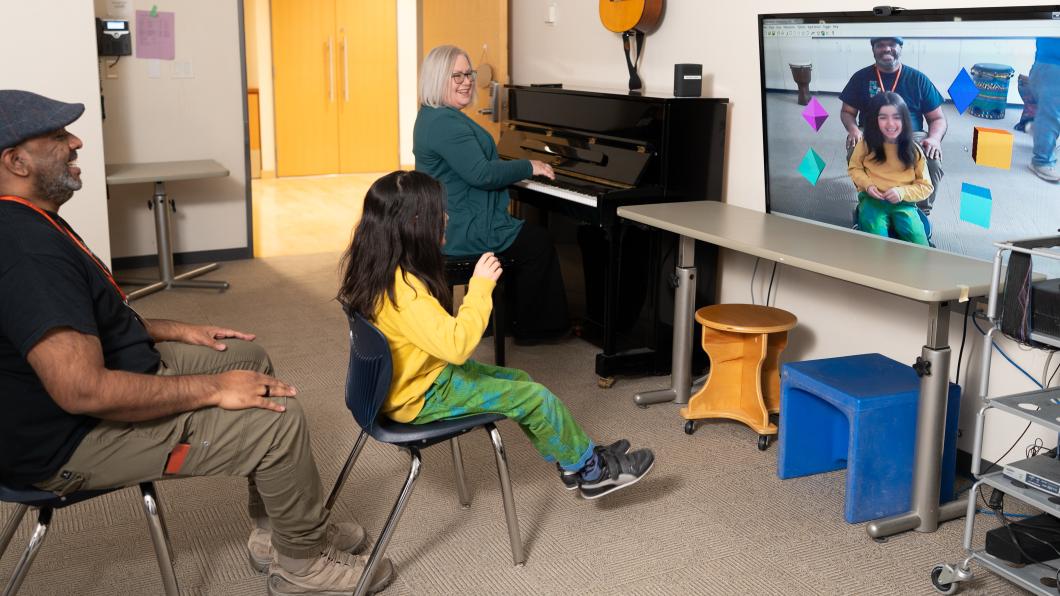
Carol Olympus, training to be a music psychotherapist, sits behind Jasper, who plays a virtual instrument. On piano is Holland Bloorview music therapist Andrea Lamont.
By Louise Kinross
For Carol Olympus, music has always been key.
As a teen in India, he played drums and guitar in bands. He also helped set up a non-profit that gave youth opportunities to stage concerts and street theatre. Later, he worked as an audio engineer and ran a concert management business in Dubai, handling live sound for artists such as Quincy Jones, Bryan Adams and the Eagles.
Today he’s a master’s student at Wilfrid Laurier University on a placement at Holland Bloorview. It’s part of his training to become a music psychotherapist. Olympus sports a purple baseball cap that matches the fringe on his beard, which his daughter dyed for him.
Music allows Olympus to work with children who are hospitalized in a unique way. “Brain scans show that when people play music, it lights up every zone in our brain," Olympus says. "That opens many channels for connection and allows us to go deep with clients very quickly.
One of his first tasks is to quell any performance fear. “I’ll say ‘Let’s make sound and see what that feels like,’” Olympus says. “If you don’t think in terms of scales and Mozart, and you just sound it out, it can express how you feel in the moment. We have this saying: ‘Music sounds like our feelings feel.’”
In the hospital’s music therapy studio, children and teens can explore a wide range of instruments, including a marimba, piano, guitar, ukulele, drums, noisemakers, shakers and a virtual music instrument.
Sitting beside a child at the piano, Olympus says he can have a conversation using sound. “If two of us are at the piano, you can hear so much of what a child is trying to say in the way they play. And they can feel your support in what you play back to them. There’s a sort of back-and-forth between the two of us that helps them feel safe enough to keep going or explore some different sounds and then come back to what feels safe. The process unfolds like we are having a dialogue but without traditional language.”
While music therapy can help a child reach physical rehab goals, music psychotherapy focuses on mental health.
Olympus decided to make a career switch when he and his family moved to Ontario at the beginning of the pandemic.
To narrow his search, he drew three circles: in one he listed his abilities, in the second he identified his passions, and in the third he wrote down what he felt the world needs. “The words that stood out were music, psychology, and people.”
Olympus’ parents were social workers, but before moving to Ontario, he didn’t know that music therapy existed. “Psychotherapy is not a regulated profession in India, and there’s no college to report to. There’s a lot of stigma about mental health in South Asia.”
He learned about the master’s program at Laurier and the school was willing to take his music industry experience into account.
When asked what qualities are most important in his role, Olympus says: “Listening to what the client is saying, listening to what they’re not saying, and listening to what they can’t say without your help. Of course, empathy and compassion are a given.”
Olympus recalls one client who appeared to avoid playing one note on his instrument. “When we spoke about it, he told me that the note sounded like aggression and anger to him, and that’s why he avoided it. That led to a conversation about a traumatic incident he hadn’t addressed before, and it opened a floodgate of emotions that we then processed together.”
If Olympus could change one thing about how inpatients are supported, it would be ensuring their psychotherapy continues after discharge. “Discharge is based mainly on physical, not psychological, rehab,” he says. “Patients leave with a list of community therapists, but someone who has been deeply vulnerable with you may not want to start over with a new person. I’d like to create a bridge where there’s a way to hold their hands for as long as they need.”
In addition to working with patients one-on-one, Olympus works with groups that have a particular focus, like sensory needs or chronic pain.
He also does online music psychotherapy with parents of children with disabilities in a program called Harmony ONTrack. It’s a collaboration between Holland Bloorview and Laurier that offers free weekly, one-hour sessions.
“Each parent has a unique story,” Olympus says. “Many open up about their deepest fears, frustrations, and anger. I aim to create a safe space that they may not have in daily life. At work, they often feel they must put on [a brave face], and at home, they play the role of the mother. In therapy, we make room for the other parts of who they are and hold them as a whole person.”
Olympus selects music that matches a parent’s mood and has meaning in their culture.
Goals may include expressing emotion, identifying and changing unhelpful patterns, and “finding or reclaiming identity or reintegrating parts of yourself.”
Olympus was initially sceptical that this work could be done online, but “I’ve been pleasantly surprised at how effective it’s been.” The online format allows parents to do therapy when it fits their schedule.
Olympus says the greatest joy of his work is seeing his patients make progress. One child had short-term memory loss and issues with speech after an injury. Olympus used melodic intonation therapy that involved singing a tune in repetition, because music helps encode a memory better than speech alone.
“A few weeks into the process he saw me from afar in the lighted bridge and remembered my name. ‘Carol!’ he yelled. “I thought ‘Oh my God, you remember my name.’ I’ve always been a believer in psychotherapy work, but in the last year at Holland Bloorview I’ve seen how music takes it to a whole different level of connection.”
To manage his own stress, Olympus “plays drums or guitar as an outlet. I’m a voracious reader, I walk, and my kids keep roping me into all these silly things.”
As a student at the hospital, Olympus says he’s grateful to participate on an interdisciplinary team. “We all bring in our experiences and insights to work towards what’s best for the client. Having a voice at the table, even though I’m just a student, and being treated like one of the team, is something I don’t see very often in a large organization. I’ve come away with the deepest respect for everyone.”
Olympus hopes to work with underserved communities. For example, “the South Asian population I understand well in terms of the cultural aspects and stigma. They are woefully underserved in the mental health space locally. They either don’t know that our service exists, or stigma prevents them from availing themselves of it. I’m hoping to fill that gap.”
Last night he was jamming with HB Rocks, a hospital program that brings together local musicians, music therapists, volunteers, students and youth with disabilities to create a rock band.
“I’ve done this back home, but the key difference, thanks to Andrea Lamont’s genius, is that HB Rocks treats the children who perform just as musicians. It’s not people with disability getting an opportunity to play on stage. It’s just a bunch of musicians coming together and having fun in the community. One client wakes up at 6 a.m. on the day of the show and lays out her music sheets and prepares. Just like any other musician would.”
Like this content? Sign up for our monthly BLOOM e-letter or take our short BLOOM survey.