

Driving a chair is a mix of freedom and frustration
By Anchel Krishna
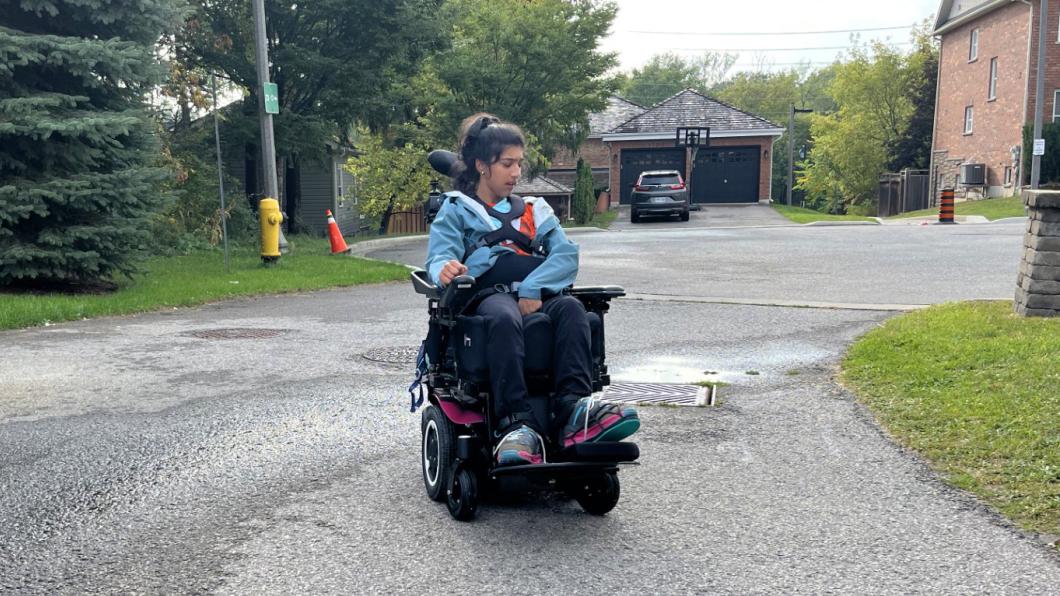
Recently my daughter Sonya, 15, started using a power wheelchair.
It has been amazing to watch her brain and body learn this new skill while she moves through the world with a little more freedom, control and independence.
But I’ve also learned that accessibility now matters in a whole new way. A small structural barrier for a power chair becomes a full stop.
Syona’s chair weighs about 300 lbs. That means we can’t lift it or bump it up to manage a single step, curb or doorway lip the way we could with her manual chair. Its traction may fail on ice. And rain, snow and slush threaten the chair’s electrical systems.
We saw these issues up close this winter.
Over a frigid March Break, Syona decided she wanted to take a city bus for the first time. We chose the library as her destination, which didn’t require transfers, and she headed out the door with her caregiver.
After getting off the bus, Syona drove until she hit a patch of ice.
Then she got stuck.
Her chair couldn’t get any traction. Her caregiver switched it into manual mode, but because of the weight of the chair and the ice, she couldn’t move it. Thankfully, a bus driver saw what was happening, pulled over and helped push the chair until the wheels regained their grip.
I was so deeply grateful for the kindness of that stranger. But I also thought: Do we need to start carrying kitty litter or road salt in the winter?
Power chairs create freedom, but require planning for situations most people never have to think about.
Another day Syona and her caregiver headed out to Pizza Pizza, which is within walking distance of our house.
When they arrived, Syona couldn’t get her chair over the entrance lip. No Pizza Pizza.
They doubled back to try Pizza Nova, and found it had an accessible entrance.
On their return, we celebrated their success, but I thought: Why are people still arriving at restaurants, stores and public spaces only to discover they can’t get in or around?
We have found some great tools to give us a heads-up on what to expect at a venue.
Access Now is a crowdsourcing app that allows users to rate the accessibility of restaurants, hotels, storefronts, parks, community centres and other public spaces. It was designed by Maayan Ziv, a Toronto entrepreneur and disability activist who uses a wheelchair. I’ve had the opportunity to hear Ziv speak, and her passion and advocacy are moving the needle in this world.
Another great resource is Access by Tay by Taylor Lindsay-Noel. The Instagram account, with 92,000 followers, posts videos of Lindsay-Noel visiting restaurants and sporting and conference venues in her power chair, and pointing out access wins and failures. Lindsay-Noel only checks out places that say they’re accessible on platforms like Google.
She recently posted that hundreds of disabled activists at an accessibility conference in Toronto were unable to hail a cab or Uber on a Tuesday night to get back to their hotels. Check out this recent interview she did with the Globe and Mail.
We haven’t travelled farther afield with Syona’s power chair yet and, if I’m honest, that is not an adventure I’m ready to tackle
Air travel comes with its own horror stories.
Even visiting a friend’s house can be complicated.
If there are stairs, we usually take Syona’s manual chair, so we can pick it up.
But that comes with a cost.
Lifting her and her chair up stairs isn’t necessarily safe. Also, she isn’t comfortable in her manual chair because she’s outgrown it. And what teenager wants to be carried around?
I never want people to not include us because of access issues. So I appreciate friends and family giving us the choice to attend, and working with us to figure it out together.
Switching gears for a moment, pun intended, power chairs are expensive machines that can be easily damaged.
A rainy afternoon can render a joystick worth thousands of dollars useless. We keep a stash of plastic bags ready to protect it, but would like to find a better solution.
Then there is the curve of learning to drive.
Syona has crashed into things. Walls, cabinets, doors, and furniture. Sometimes these mishaps break the chair’s foot plate or joystick or another component, causing a steady cycle of repairs. We’re fortunate to work with a responsive and resourceful medical equipment company.
A friend whose adult child uses a power chair warned me to say goodbye to my walls, and she was absolutely right. I’ve accepted that the wear and tear is part of the landscape of our home. It adds character, I tell myself, and is the price of learning.
The safety of others around a power chair is also a concern. Power chairs are heavy and dangerous if you run over someone’s toes.
What no one prepared us for were people walking directly into Syona's path. People step in front of her constantly, assuming she will stop instantly or move around them.
It took a lot of coaching to teach Syona to stop driving when someone crosses her path.
Crosswalks feel rushed. The countdown starts and suddenly getting across the street feels like a sprint, except sprinting is not exactly an option.
None of these problems should be Syona’s to carry. The problem is not her chair. It’s the world around it that was not designed with disabled people in mind.
The responsibility for fixing that belongs to all of us.
The truth is, we all benefit from universal accessibility. Parents pushing strollers, people recovering from injuries, older adults, people with temporary or permanent mobility challenges. A barrier-free entrance helps everyone.
Like this content? Sign up for our monthly BLOOM e-letter or take our short BLOOM survey.