
Advancing precision health for children and youth with disabilities and developmental differences
Two children can have the same diagnosis and still have very different strengths, challenges and needs. At the same time, children with different diagnoses can sometimes have more in common than their labels suggest.
For Dr. Marlee Vandewouw, that raises an important question: What if research could help us better understand what makes each child unique - and ultimately help personalize the care and support they receive?
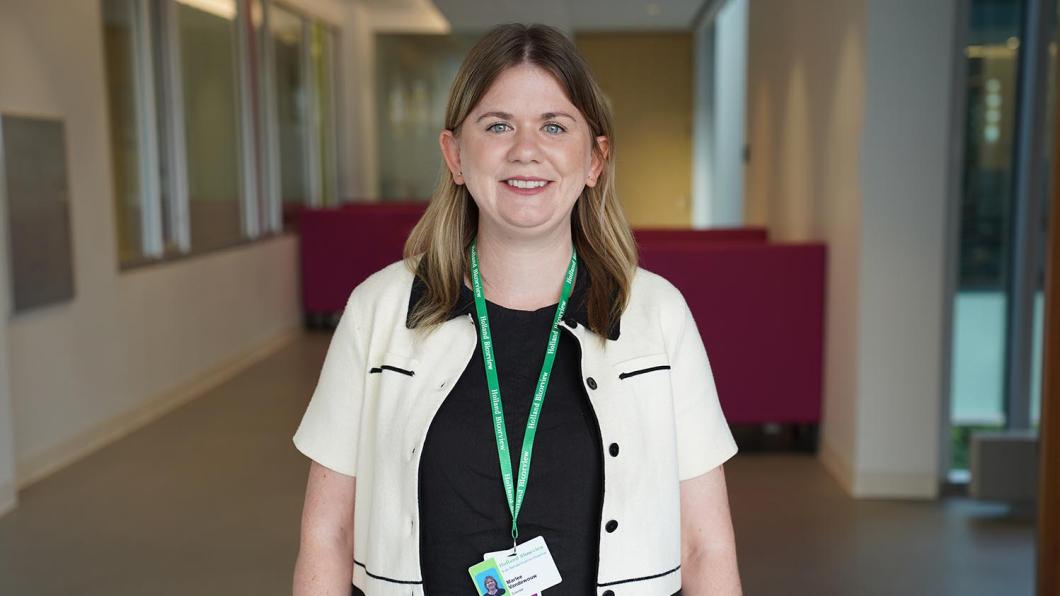
It's a question at the heart of the research program Vandewouw brings to the Bloorview Research Institute (BRI), where she joined as a scientist on Aug. 4.
Her work focuses on advancing precision health for neurodivergent children and youth. She brings together different types of information about an individual - including brain imaging, genetics and clinical information - and uses tools such as artificial intelligence (AI) and machine learning to look for patterns that could help researchers better understand individual differences.
“There's a lot of variability within the diagnostic categories of neurodevelopmental conditions and also overlap across them,” says Vandewouw. “That's where the precision health piece comes in: How can we approach that in a way where we're looking at an individual rather than a broad group?”
From engineering to understanding the brain
Vandewouw's path to neurodevelopmental research has taken her through mathematics, engineering, brain research and genetics.
She completed a bachelor's degree in applied mathematics and engineering at Queen's University before earning a master's degree in industrial engineering and a PhD in biomedical engineering at the University of Toronto. Most recently, she completed a postdoctoral fellowship at the Center for Precision Psychiatry at Massachusetts General Hospital and Harvard Medical School, where she expanded her experience in genetics and other areas of precision health research.
“I started out in math and engineering, but I kept getting pulled toward the brain and understanding how its development shapes who we are. Precision health is where the data kept leading me - the closer I looked, the clearer it got that no two kids are the same, and this is the field built around recognizing that.”
During her postdoctoral fellowship, Vandewouw was also involved in research using neurofeedback, an approach that provides people with real-time feedback about their brain activity.
“During my postdoc, I worked on several neurofeedback trials, where people watch their own brain activity in real time and learn to shift it themselves. There's something powerful about that moment - seeing, on a screen, that your own brain isn't fixed, and that you have some ability to change it. It's a direction I'd like to keep building on at BRI.”
Today, Vandewouw is exploring what researchers can learn by integrating different types of data that have traditionally been studied separately. By bringing together information about a child's brain, genetics, health and development, her research aims to build a more complete picture of the individual child.
One of her current projects explores how this deeper understanding could eventually lead to more personalized care. Working with BRI senior scientist Dr. Azadeh Kushki and other Holland Bloorview researchers, Vandewouw is studying whether AI could help support more tailored medication decisions for children with neurodevelopmental conditions.
Finding the right medication can sometimes involve trial and error, potentially requiring children to try several medications and experience side effects along the way. Vandewouw and her colleagues developed AI models that use information about an individual child to predict the type of medication a specialist might prescribe. In the future, research like this could help make specialized knowledge available in communities that don't have access to programs like Holland Bloorview's Psychopharmacology Program.
Coming back to BRI
While Vandewouw's role is new, BRI is familiar territory.
She previously trained at BRI as a graduate student during her PhD, working with Kushki. She later worked at BRI as a research associate and was the recipient of BRI's 2024 Pursuit Award. After completing her postdoctoral training in Boston, she now returns as a scientist and assistant professor in the Institute of Biomedical Engineering at the University of Toronto.
“This is where I did my PhD and where a lot of how I think took shape, so coming back to lead my own lab feels full circle. I'm looking forward to growing my research here in such a supportive environment, and to working with the patients, families, clinicians and scientists that make BRI such a special place to do research.”
“We're thrilled to welcome Marlee back to BRI and have her help advance precision health across the institute,” says Dr. Evdokia Anagnostou, vice president of research and director of BRI.
“Her expertise in genomics, neuroimaging and data science will strengthen our capabilities in this area and help us advance more personalized approaches for children and youth with disabilities and developmental differences. Fuel Precision Health is one of BRI's four strategic priorities, and our ambition is to better understand what works, for whom and under what circumstances, and translate that knowledge into solutions that reflect the needs, characteristics and priorities of individual children and families.”
Vandewouw will also establish the Multimodal Neurodevelopment Lab, or MiND Lab, at BRI, where she will continue building her research program and collaborating with researchers across disciplines.
Outside the lab
There's more to BRI's newest scientist than brain imaging, genetics and data.
“Outside the lab, I'm making up for lost time on Toronto's food scene - being away for my postdoc meant a long list of restaurants to get back to. I'm also a sports fan - hockey, Formula 1, tennis, baseball, I'll watch most things - but I'm an Ottawa Senators fan first, which makes living in Leafs territory character-building.”
For Vandewouw, joining BRI as a scientist marks both a homecoming and the beginning of a new chapter - returning to a research community that was part of her own development, now with a lab and research program of her own.
By Priyanka Shah