
Q&A with Emnet Goitom, a summer student at the Bloorview Research Institute
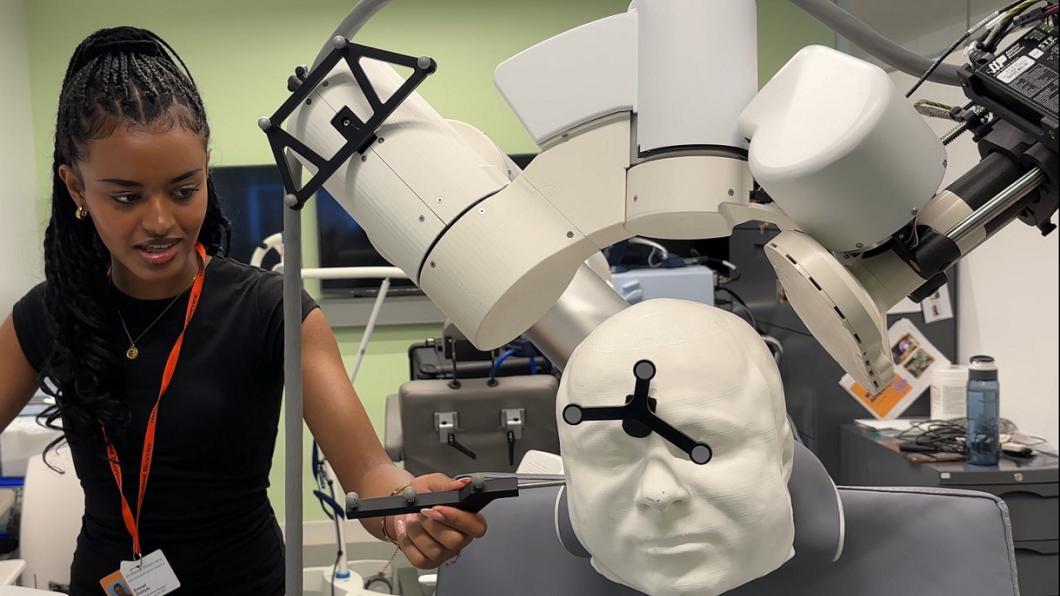
[Pictured above]: Emnet Goitom, a McMaster University student, calibrates the robotic transcranial magnetic stimulation (TMS) system for brain mapping.
Working towards a career as a physician-scientist dedicated to improving care, Emnet Goitom applied to the Ward Family Summer Student Research Program - one of the only programs in Canada that gives undergraduate students hands-on experience and mentorship in childhood disability research.
Since May 4th, Emnet and 23 other students have been working with scientist-mentors at the Bloorview Research Institute (BRI) to help unlock new possibilities for children with disabilities and developmental differences and their families.
Emnet is supervised by Dr. Deryk Beal in the CONNECT Lab. He shares:
“Mentoring Ward students bring fresh questions and perspectives to our work. Emnet brought a unique perspective to the lab and was eager to explore ideas beyond her previous research experience. I'm excited to see where her curiosity and dedication take her next.”
Read more about Emnet’s experience:

[Pictured above]: Emnet (left) learns to use the Brainsight neuronavigation system alongside supervisor Dr. Deryk Beal (right).
Can you explain your research project?
The focus of the project is to understand the brain mechanisms that support communication. At the CONNECT Lab, we examined how the brain supports speech adaptation, which is the ability to automatically adjust speech in response to altered auditory feedback. Using behavioural measures and MRI data, we examined how brain structure relates to speech adaptation. Our findings challenged our original hypothesis, showing that white matter connectivity, not cortical thickness, was more strongly associated with adaptation. This offered new insights into communication processes relevant to children and youth with neurodevelopmental and acquired neurological conditions.
What has your experience in the program been so far?
What’s so unique about the BRI is that there are so many different areas of research that intersect and impact clinical care. I have met incredible researchers in the elevator going down to get lunch. I’ve had conversations that I didn’t think I would have about speech motor control, engineering, rehab sciences and even how games can help with cerebral palsy.
Can you describe the research you’re doing at McMaster University?
My research focuses on the mental health of Eritrean refugees who have moved to Canada. I’m studying how trauma experienced before, during and after migration affects mental health. This includes the stress of dangerous migration journeys, as well as challenges such as finding housing, learning a new language and navigating the legal system.
Because most mental health research and diagnostic tools were developed in Western countries, they do not always capture how distress is experienced in other cultures. This can make it harder to accurately identify and diagnose mental health concerns in refugee communities.
What are your future career and academic goals and how do you believe this experience will help you get there?
I want to be a physician-scientist in neuropsychiatry because there is so much unexplored potential for discovery and innovation to improve outcomes among underserved communities. More specifically, I am driven by the lack of culturally validated diagnostic tools for newcomers. The current methodologies we have often fail to capture the realities of their displacement; it’s very difficult to improve outcomes for communities when we aren’t clearly capturing their suffering.
I’ve spent the summer developing skills in participant-based research and transcranial magnetic stimulation (TMS) technology. The neuroscience experience complements the community-focused mental health research I do at McMaster. By combining my work in migration-related trauma with a deeper understanding of the brain, I hope to build a career that bridges research, advocacy and clinical care.
Is there anything else you want to highlight?
Research is valuable because it can legitimize the voices of underserved communities. It allows information to be spread to mobilizers like clinicians or policymakers who can make a difference.
Even when findings are unexpected, there is still value in documenting what communities are facing and learning how to ask better questions. If we keep documenting and mobilizing change, whether that be for youth with communication challenges or immigrants navigating a new country, there is room for research and advocacy to intersect.
Story and photos by Zoe Davidson