


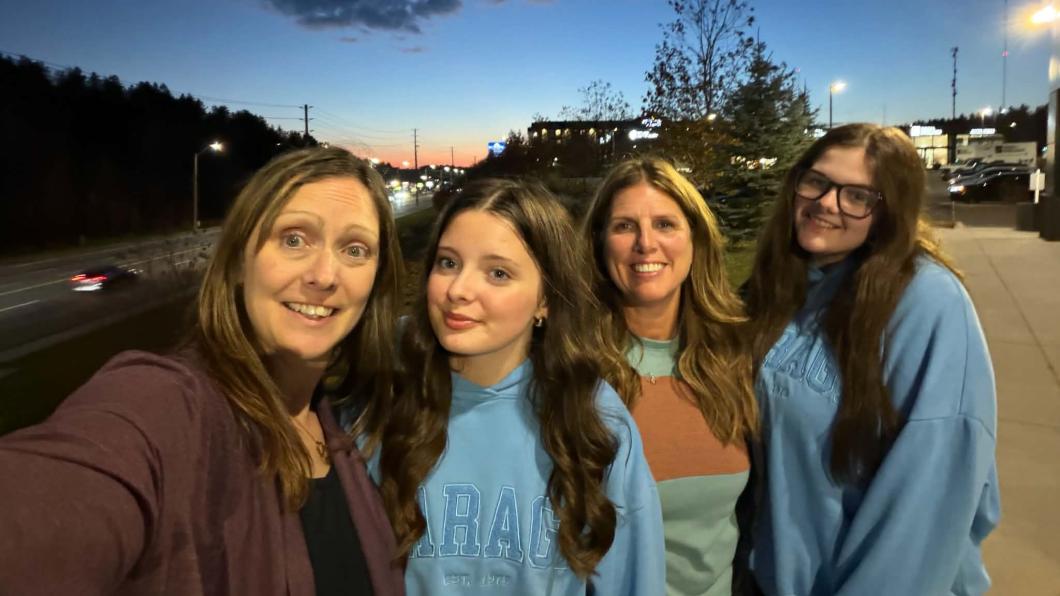
Two girls with pain. One hospital program. 'It was life changing'
By Louise Kinross
Before attending Holland Bloorview’s Get Up and Go program for children with chronic pain, Jenna Campeau, 17, from Sudbury, Ont., had given up school and sports and spent her days in bed. Elise Barry, 14, also from Sudbury, had a similar story. Both girls have complex regional pain syndrome. It often develops after an injury when a person’s nervous system becomes overly sensitive, and pain persists. Both girls were inpatients in a program where they attended school, exercised in the gym, pool and outside, and learned strategies to manage their pain. “It was life-changing,” Jenna’s mom Cindy says. BLOOM spoke to Jenna, Cindy, Elise and her mother Stacey.
BLOOM: Let’s start with the young women. How did pain impact your life?
Elise: The pain was so bad I couldn’t get out of bed and do things, like go to school or hang out with friends. I was basically crying all day. I had pain in my arm, neck and back. It was a random thing that happened.
Jenna: It really affected my attendance in school, and my grades would drop and I had to stop my sports, which were mainly hockey and horseback riding.
BLOOM: Did you try other treatments?
Cindy: Jenna tried physiotherapy, occupational therapy, psychotherapy, chiropractors, massage, sports medicine doctors, athletic therapists, acupuncture and foot and ankle doctors.
Elise: Yes, we tried everything. I did hypnosis too.
Cindy: You have this kid who was an athlete with a big group of friends and a good student and then her whole world becomes about this pain and trying to find answers and not being able to get them. Before we went into Bloorview, we were at rock bottom, emotionally, physically and mentally.
BLOOM: How would you describe Get Up and Go?
Jenna: Every worker was beyond sweet and helpful and were like cheerleaders. They try to get you back to doing the things you like. For me they focused on riding. We set up a yoga ball and cushions to imitate riding a horse with a saddle and stirrups.
Cindy: Another example is they had Jenna bring her hockey skates and downhill ski boots to the hospital and they set little goals over four weeks. First it was to get a sock on and then a shoe. Then to sit with hockey skates on. She was almost ready to drive, so they rigged up a gas and brake pedal so she could work on that motion.
Elise: They taught me how to take breaks in the day to make sure my pain didn’t get worse. We did physio and I noticed an improvement in my movement. And we learned how to sleep better.
Jenna: I learned not to hang out in bed because it’s only good to be in bed when you’re asleep. And if I can’t sleep, I get up and do something boring. In the morning I would shoot pucks in the gym to try to get back to activities that seemed normal. But I would take it slow and not run around.
I got more confident there knowing there are people on my side and supporting me and I’m not alone going through everything.
Elise: I had to accept that my life wasn’t going to be the exact same as it was before, but I could make it close to what it was by using strategies like pacing myself.
Cindy: We would come home on the weekend, and I would see Jenna using the strategies she was learning. She’d say: “I want to go do this tonight, so I’m going to stay home this afternoon and rest.’ Or ‘My pain is flaring up, so I’m going to do art therapy. I’m going to sit here and scrapbook because that’s going to distract my brain from the pain.’ She came out a different kid than she went in.
Jenna: I had to reprogram my brain. It’s like a fire went off when I initially had my sprain injury, and then the alarm just kept going off, even though the fire was out. For example, I had to teach myself that walking was not a danger zone and it’s okay to do it.
Cindy: Jenna learned she can still live her life, but with accommodations and in smaller pieces. So maybe she can’t go for a five km. hike, but she can start with small walks. I remember us celebrating the first time she walked to the corner and back.
Elise: I had to shift my thinking from ‘I wish I had my life before this happened’ to ‘I’m relearning to do things that I couldn’t do before. Like I can write now, and I’m getting better.’
BLOOM: Let’s talk more to the moms. You had one-on-one counselling with Miriam Blond, the social worker, and parent groups with Miriam and Lori Palozzi, our nurse practitioner. What did you learn?
Stacey: We’re parents of teenagers, so we’re learning how to let go of responsibility and let them come into themselves. But when your child has pain you can’t help, it’s hard to let go. We learned that the motivation and healing had to come from the girls. We had to learn how to let them take the reins and how we could be more of a coach, rather than saying: ‘You need to do your physio and you need to do that.’
Our whole family learned these strategies. My husband would sit in on meetings virtually.
Cindy: Miriam would often ask us ‘What do you value in this situation? So if I see Jenna is having a bad day and in pain, I need to step back and ask: ‘What do we want from this situation?’ Well, I do value her going to school. I would ask Jenna: ‘What will you be able to handle today?’ And maybe she’d say: ‘I’m going to go to two classes today’ and we would work with that plan. Instead of me constantly asking her what level her pain was at until she’d break down and cry.
BLOOM: Elise, I understand you met Jenna before you came into our program last summer. How did that impact you meeting someone else with the same condition?
Elise: It was really nice because she told me everything about the program and she had had pain longer than me and said I could ask her any questions.
Jenna: And now she’s like my little sister.
BLOOM: It sounds like it’s been valuable for you to connect as parents?
Cindy: Stacey and I texted a lot and then when we first met we just gave each other a big hug right away. It was like we’d known each other forever.
BLOOM: What would you like the public to know about chronic pain?
Cindy: That CRPS is real. It’s not these kids being lazy, or you know, being dramatic. It’s a real thing that affects them physically, socially and academically. And the impact on their mental health is huge.
BLOOM: Jenna, I think you were going to say something about accepting the pain?
Jenna: It’s been over two years now, and I still have days, of course, where I don’t want this pain. I want it gone. But I know how to cope with it better. I understand what’s happening to me.
Let’s say I take a day off school because sometimes you need those days. To this day, I know exactly where my binder is from the hospital, and I’ll go and look at all of the things we learned. I’ve gone through so much and I know it’s super important to be strong. And I’ll text Elise and say: ‘How are you doing?’ and we’ll at least talk to each other.
Like this content? Sign up for our monthly BLOOM e-letter.
