


What I post online about my daughter and why
By Robin Koczerginski
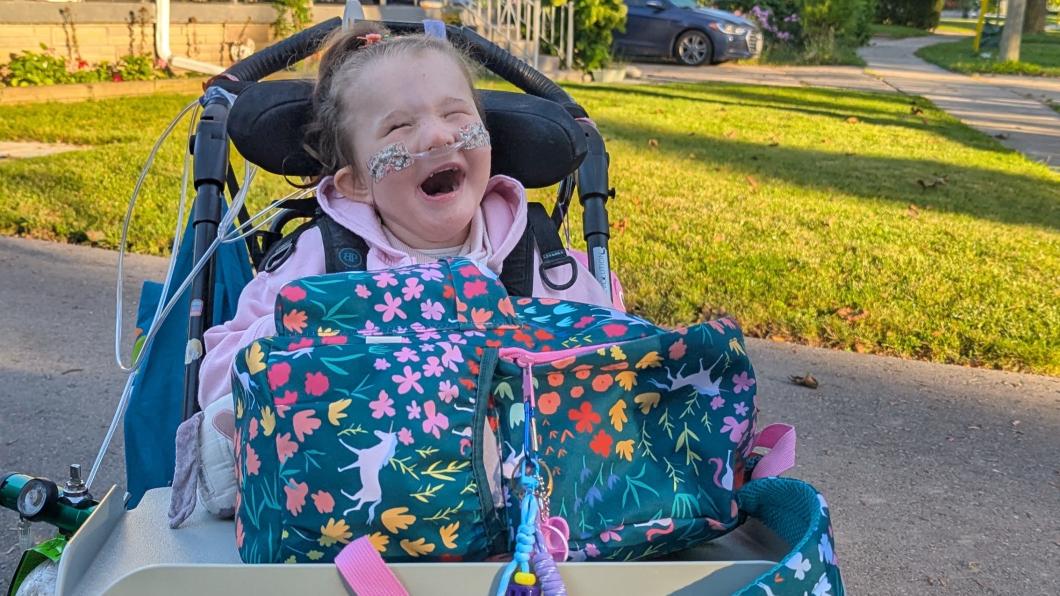
Bree, my daughter (above), is laughing with her whole body, head pressed back into the headrest of her wheelchair, eyes squeezed into two crescents, mouth open as wide as it goes at something just outside the frame, oxygen tubing taped across both cheeks and looping down past her shoulder to the tank riding shotgun on the side of the chair. She is sporting her gold sandals, a choice we made for her, not that she seems to care or even notice. Her backpack sits on the removable tray attached to her chair as she waits for the bus to arrive for her first day of school.
I posted the picture on my Instagram with the caption "First day of SK for this little munchkin #trisomy13." When Bree was first born, I never allowed myself to even imagine Bree living long enough to be in kindergarten. Now that she is, I want to let the world know that she is here and thriving, so people who don't know her might see her as more than just her genetic condition and disabilities. Plus, I'm her dad, a millennial, who wants to show off how damn cute my kid is. I've been doing this for five years now. I decide what the world gets to know about my daughter, which is, at the end of the day, an enormous responsibility.
I started posting about Bree early in her life to respond to the flood of family and friends asking for updates. We were only expecting Bree to live for a few weeks, so having a record of her on the internet was the least of our worries. But besides wanting to send timely information to loved ones, something else drove me to share her story with the world. I wanted to change the narrative about Bree, and kids like her, from the ones that I kept on seeing online.
There's the tragedy version posted almost exclusively by those who have no relationship with children like Bree, where the child is something that happened to a family, and everyone speaks about them in the tone reserved for funerals and bad news.
On the flip side, there's the inspirational version, which frames Bree as a miracle child we can learn from because of her resilience, which is just another way of saying that simply being alive is the low bar set for her. There's the "I don't know how you do it" sentiment, which is intended as a compliment and but can land like a critique of our whole life. Sometimes the subtext on everything feels like a general assumption that our house must be a sadder place than yours.
So sharing about Bree is also filed under the larger category of advocacy in my mind. I try to show Bree and our family's life with some balance of the difficulty of parenting a medically complex, disabled child, so nobody mistakes this experience for something removed from the real challenges, with enough of the joy that nobody mistakes Bree for a burden on us. It's curated, in the sense that I pick the moments, the angles, the ratio, and the public-facing narrative of her life for her.
I have heard the valid argument that because she can't consent, I should limit what I publish about her. After all, sharing anything online is taking advantage of a kid who can't push back. That is a position I respect and have no issues with.
The way I think about this with Bree is that if she could understand now, or someday in the future, what gets written about her, publishing may put her well-being at risk. She might find a description of her own worst morning and have to live inside it afterwards, perhaps carry it into a classroom, and measure herself against it.
That possibility is one of the reasons these decisions feel so complicated to me. When another person cannot meaningfully participate in the decision, there is no formula for knowing where the line is. All you can do is think carefully about what you’re sharing, why you’re sharing it, and who ultimately benefits from it.
This topic of “sharenting,” a term to describe parents over-sharing their children's intimate lives online, isn’t unique to kids with disabilities. No child can consent to being shared about publicly online. Even if they say “yes," they’re too young to understand what that information might mean years later. As parents, we’re constantly making decisions on their behalf while trying to balance privacy, autonomy, advocacy, connection, and our own desire to tell the stories of our lives.
I used to share more about my older daughter, and over the years I've become more conscious of the responsibility that comes with telling someone else's story online. Bree's situation isn't a different category, but there is one key variable removed.
Bree won't read this, and nobody's going to read it to her to be cruel. She won't understand the concept of consent or grasp what social media is. I've spent five years learning what reaches her and what doesn't, and I feel confident that written accounts of her life do not carry the same potential for emotional harm that they might for many other children, now or in the future.
In Bree's case, after conversation and agreement with my partner, we choose on her behalf knowing that the considerations we weigh are different. What I’m weighing is whether I have the right to build a public version of a person who can't correct it in the name of advocating for a better life for her and kids like her. I also weigh whether this story is hers to tell, or solely mine.
This version of a conversation plays out differently in every house. That's why I've got nothing for readers that looks like a rule or concrete advice. Your kid isn't my kid. If yours takes in more than mine does, your line sits somewhere else entirely, and anyone who tells you where to draw it without knowing your child is wrong.
But the absence of a hard rule isn't the same as the absence of a standard.
Every parent should reflect on the purpose of sharing in situations when you don't have explicit consent from your child. Be honest about who it's for, because it's almost never only your kid. Sometimes it's the family three months behind you. Sometimes it's a care professional who views your child only through a medical model. Sometimes it's for you, tired in the evening, wanting one person to understand what the day was like.
Anytime I share about Bree online I run through a handful of questions.
Would I post this about her sister? Does this share who Bree is, or who I want her to be seen as when I talk about her? Am I posting it to get a reaction? If she could read it at age 25, even if I know it's only hypothetical, would she be angry at me? Am I writing about her today or in the past?
Answering these questions is not like following a decision tree that leads to either "post" or "don't post." They just help me think critically about the decision. At the end of the day, as parents, we are constantly making decisions about what's best for our children.
Sometimes, I get it wrong. For example, recently I posted a picture of Bree on Instagram when she was less than an hour old in the NICU, hooked up to wires and clearly very fragile. My intention was to show the world the contrast between her then and now.
But something about it didn't sit right with my partner. She wasn't sure what made her feel uncomfortable. Maybe it had crossed an imaginary ethical line by inviting the public into a private, intensely personal moment in our family? My partner's gut reaction was that she didn't want it posted. I respected and agreed with her feelings, and took the post down.
Ultimately, we are building a permanent record for someone who never agreed to it. We owe it to them, at the very least, to keep asking the questions, even when we know we'll never get a perfect answer.
Robin Koczerginski is a communications professional. He is writing a memoir and is represented by Amy-Moore Benson at CookeMcDermid. SOFT has more information about Trisomy 13.
Like this content? Sign up for our monthly BLOOM e-letter.