

New initiative gives clinicians more adaptive gaming options for clients
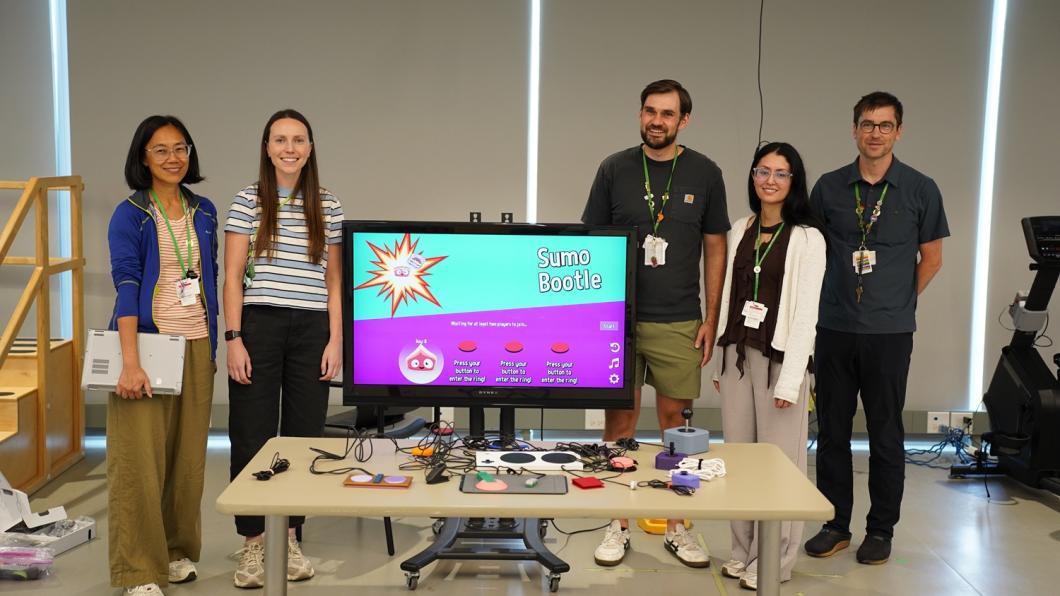
Clinical and BRI team members [L to R]: Yvonne Ng, Victoria Paoli, Carter Wickson, Mursal Rizaey and Alexander Hodge pose with some of the inclusive gaming hardware on display.
Ask a child or teen about their favourite pastime, and video games will likely top the list. According to the Canadian video gaming industry, 61 per cent of Canadians enjoy playing video games.
Occupational therapist Victoria Paoli sees this interest among her clients each day. While many children and youth enjoy video games, the equipment is often not designed with accessibility in mind. For example, many controllers require two-handed use. Children and youth with cognitive or visual differences may also face challenges with fast-paced gameplay, quick responses to decision-making or interpreting on-screen visual cues.
 “Gaming has increasingly been identified as a meaningful therapy goal for children and youth, providing opportunities to build participation, motor skills, cognitive skills, problem-solving and social engagement through an activity that is motivating and personally meaningful,” says Paoli. “However, clinicians often lack access to adaptive gaming equipment, resources, or training needed to effectively support these goals.”
Addressing the gaming gap
To help address this gap and meet growing interest, a small team of clinicians led by Victoria have been collaborating with Alexander Hodge, a senior game developer with Possibility Engineering and Research Lab (PEARL) for the past year and a half to create customized gaming solutions. Other team members include Michelle Lee Chong, Jennifer Morin, Susannah Van Damme, Yvonne Ng and Carter Wickson.

Alexander holds an Xbox console retrofitted with a 3D-printed controller attachment created from a design downloaded from Makers Making Change’s website. This was custom-made for an inpatient client so they could play video games with one hand.
Until recently, these efforts relied on staff adapting video gaming equipment through 3D printing or using controller attachment designs from Makers Making Change, a Neil Squire program that empowers Canadians with disabilities through technology. While helpful, this approach was not sustainable.
Victoria saw an opportunity through Makers Making Change’s GAME Checkpoint initiative as a valuable resource, giving clinicians access to adaptive gaming equipment, accessible games and skills needed to create individualized gaming solutions for more clients.
Inclusive gaming for all kids
Thanks to funding from a hospital capital grant as well as equipment donated by Makers Making Change with funding from the Craig H Neilson Foundation, Holland Bloorview can now offer adapted gaming equipment as a bookable resource and offer training for interested clinicians.
Holland Bloorview will be the organization’s first children’s pediatric hospital in Ontario to partner on adaptive gaming technology, joining a network of 13 other rehabilitation centres to share knowledge and make gaming more inclusive to all.
 “We’re exciting to welcome Holland Bloorview to our GAME Checkpoint network, connecting them with rehabilitation centres across Canada to share knowledge and work together to advance adaptive gaming,” says Tyler Fentie, accessible gaming lead of Makers Making Change. “By bringing together our expertise in adaptive technology and accessible gaming with Holland Bloorview’s clinical expertise, we can give clinicians the tools and knowledge they need to help more young people play their way.”


Access will be available to two mobile gaming units outfitted with gaming consoles, a high-powered laptop, a tablet and a range of adaptive gaming technologies including think switches, joysticks, mounting options and specialized controllers. Clinicians from inpatient and ambulatory units will share their newly acquired knowledge with colleagues, helping to build sustainable adapted gaming expertise throughout the hospital.
 “My hope is that this partnership will empower clinicians to find more personalized pathways to incorporate gaming into individualized goals for clients who are interested so that more kids can experience the joy of playing independently and with their loved ones,” says Hodge. “I am so proud of our clinical team who pushed this idea forward and for the partnership with Makers Making Change.”


Clients and clinicians try out the adaptive gaming devices at an open house on Oct. 2.
 “Seeing the joy on clients’ faces while they play their favourite games is incredibly rewarding, but the impact goes even further,” says Wickson, a therapy recreation assistant. “These experiences can help children and youth grow their confidence, foster independence, and find new ways to express themselves.”
Story by Suelan Toye
Photos by Brendan Bryne and Suelan Toye